Most people in Dubai who ask us about Hijama have already heard the word "Sunnah" attached to it somewhere — from a friend, a Friday khutbah, a forwarded WhatsApp voice note. They know it is a recommended practice. What they usually do not know is what specifically makes a Hijama session "Sunnah," and what is just marketing language pinned onto a generic cupping treatment.
This piece is for anyone trying to understand that difference properly. Not in a rushed paragraph, not with cherry-picked hadith, but in the patient detail the topic deserves. We will go through what the Prophet ﷺ actually said and did, the Hijri days that scholars highlight, the body points named in the narrations, and the etiquette that surrounds the session. We will also be honest about where the scholars differ, because pretending otherwise does no one any favours.
If you are looking for a fuller walkthrough of what physically happens in a session — the cups, the blade, the aftercare — read our complete guide to Hijama in Dubai alongside this one. This post is more about the why and the when.
What "Sunnah Hijama" Actually Means
Hijama (حجامة) by itself just means cupping — the controlled drawing of a small volume of stagnant blood through the skin using suction and superficial scratches. You can find that procedure in clinics from Beijing to Bristol. It predates Islam by thousands of years.
Sunnah Hijama is something more specific. It is the same therapy, performed in line with what the Prophet Muhammad ﷺ recommended and practised: on certain days of the lunar month, on certain points of the body, with a certain intention behind it, and within an etiquette that treats the session as something more than a clinical procedure. When a clinic genuinely offers Sunnah Hijama — not just borrows the word — these things should be visible in how they schedule, how they explain, and how they perform the session.
So is hijama sunnah? Yes — not in the sense of a hard obligation, but as a practice the Prophet ﷺ encouraged, performed himself, and instructed others to perform. That is exactly the meaning of Sunnah here.
The Hadith Evidence
The narrations on Hijama are unusually rich. We will not list every chain — that is a job for scholars — but here are the ones most commonly cited and most relevant to anyone trying to align their practice with the Sunnah.
"Indeed, the best of remedies you have is Hijama (cupping)."
— Sahih al-Bukhari 5371; also Sahih Muslim 1577.
This is the foundational text. The Prophet ﷺ ranked Hijama among the most beneficial treatments available to his community. Notice the wording: not the only remedy, not a cure for all diseases — the best of the remedies. That is a careful claim, and worth keeping in mind whenever someone tries to oversell the therapy.
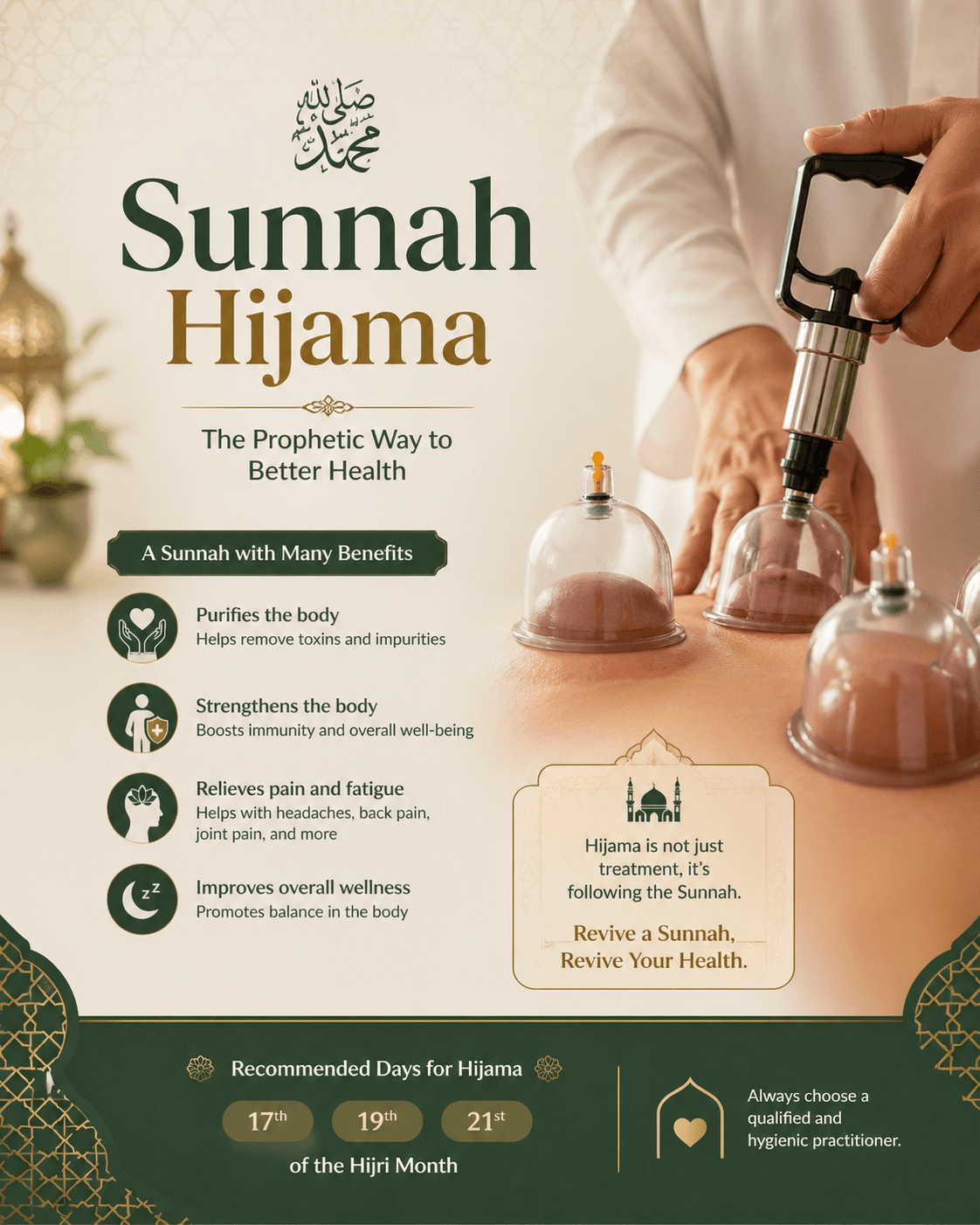
"Whoever performs Hijama on the 17th, 19th, or 21st (of the lunar month), it will be a cure for every disease."
— Sunan Abi Dawud 3861; Sunan Ibn Majah 3486.
This is the hadith that gives us the famous "Sunnah days." The chain is graded by scholars as hasan (sound) in most assessments, with some classifying it stronger, some weaker. Either way, it is the textual basis for why so many UAE clinics, including ours, see a sharp spike in bookings around those three Hijri dates.
"The Messenger of Allah ﷺ used to have Hijama performed on his head and between his shoulders, and he used to say: 'Whoever sheds any of this blood, no harm will come to him if he does not seek treatment for anything else.'"
— Sunan Abi Dawud 3859.
Two things to notice here. First, the locations: the head and between the shoulder blades — points we will return to in a moment. Second, the framing — Hijama as something complete in itself, not a junior therapy to be combined with everything else.
Two further narrations are worth knowing. Anas ibn Malik reported that the Prophet ﷺ was cupped on the two veins at the sides of the neck and between the shoulders (Tirmidhi 2051). And in another narration, Hijama on an empty stomach is described as more beneficial (Sunan Ibn Majah 3487). Different scholars handle the latter narration with varying confidence in its chain, but the practical point — that fasted or near-fasted is preferred — is widely accepted.
The Sunnah Days: 17th, 19th, 21st of the Hijri Month
The three dates the Prophet ﷺ singled out — the 17th, 19th, and 21st of the Hijri month — are the heart of what people mean when they search for "sunnah days hijama" or "17th 19th 21st hijri hijama." They are odd-numbered, they fall in the second half of the lunar month, and they cluster around the time when the moon is waning from full.
Classical scholars offered a few explanations for the wisdom behind these dates. Imam Ibn al-Qayyim, in Zad al-Maʿad, suggested that during the second half of the month the body's blood is at its peak settled state — having risen with the lunar cycle — and is therefore most ready to be drawn off. Modern readers can take that as imagery rather than physiology; the underlying point is that there is a rhythm to the body, and the Sunnah dates are a way of honouring it.
What about Monday and Thursday? There is a separate set of narrations encouraging Hijama on Mondays, Tuesdays, and Thursdays, and discouraging it on Wednesdays and Saturdays. The most widely cited version comes through Ibn Majah and Abu Dawud. Scholars have debated the strength of these chains, with some — including Imam Ahmad — being cautious about them. The practical takeaway most contemporary scholars settle on is this: if your Hijri 17th, 19th, or 21st falls on a Monday or Thursday, that is considered a particularly good combination. If it falls on a Saturday or Wednesday, many people in our diary still book it without concern, because the day-of-week narrations are not as strong as the Hijri-date ones.
So when is the best day for hijama? The answer most patients land on, after asking their own scholar: the 17th, 19th, or 21st of the Hijri month, ideally on a Monday or Thursday, ideally in a near-fasted state, ideally in the morning. Hit two of those four and you are well within the Sunnah.
The Sunnah Body Points
The narrations are surprisingly specific about where the Prophet ﷺ had cupping done. Three locations come up repeatedly.
- Al-akhdaʿain (الأخدعين) — the two veins on the sides of the neck. These are the points where the side of the neck meets the upper trapezius, just below the hairline. Cupping here is associated in the hadith with relief for headaches, the eyes, the face, and conditions affecting the head and upper body.
- Al-kāhil (الكاهل) — the area between and just above the shoulder blades, at the base of the neck. This is the central point of the upper back. Many narrations describe the Prophet ﷺ being cupped here, and it remains the single most commonly used point in clinical Sunnah Hijama today. It is the point most patients in Dubai start with.
- The head (raʾs). The Prophet ﷺ was cupped on the crown of the head, particularly when in a state of ihram during travel. This is a more specialised point and not used in every session.
Beyond these three, narrations and classical practice mention points on the lower back, the hips, the upper thighs, and either side of the spine. Modern Sunnah Hijama clinics — including ours at Royal Treat — typically combine the central Sunnah points (especially al-kāhil) with additional points chosen based on the patient's complaint. So a patient coming in for migraines might receive cups on the head and neck region; a patient with sciatica gets points along the lower back and hips. The Sunnah points anchor the session; the complaint-specific points extend it.
For deeper context on point selection by complaint, our pages on Hijama for back pain and Hijama for migraine describe the typical layouts we use.
Sunnah Etiquette Around the Session
The Sunnah is not just about the date and the points. There is a whole texture of practice around the session that shapes whether it feels like a treatment or like a small act of worship.
- Niyyah (intention). Before the cups go on, take a quiet moment to set your intention — that you are following a Sunnah, asking Allah for shifa, and treating this body He gave you with care. The same physical session done with niyyah carries a different weight.
- Fasted or near-fasted state. The hadith literature suggests Hijama is more beneficial on an empty stomach. Practically, two to three hours after a light meal works fine. A heavy biryani lunch right before a session is the wrong approach.
- Days many scholars discourage. As mentioned, some narrations discourage Wednesday and Saturday for Hijama. Scholars differ on the strength of these reports. If you want to be cautious, avoid those two; if your Hijri date falls there, consult someone you trust before deciding.
- Morning preference. Most classical practitioners performed Hijama in the early part of the day. Energy levels are clean, the body has rested, and the rest of the day can be used for recovery.
- What to do after. Rest. Drink water. Eat lightly — fruits, soup, lean food. Avoid red meat, heavy fried food, dairy, and intense exercise for at least 24 hours. Many take this as an opportunity to also tend to their salah and dhikr; the calm after a session lends itself to that.
Modern Clinical Safety: Sunnah Is Not an Excuse for Poor Hygiene
We need to be very plain about something here. Sunnah Hijama, performed in 2026 in Dubai, must meet every single one of the modern safety standards expected of any minor invasive procedure. There is nothing in the Sunnah that justifies cutting corners. The Prophet ﷺ encouraged what was clean and forbade what was harmful. A dirty Hijama is not a Sunnah Hijama.
What that means in practice:
- Single-use, sterile blades. Opened in front of you. Disposed of in a proper sharps container in front of you. No reuse, ever, between patients or even between points on the same patient where contamination is a risk.
- Sterile, single-use cups. Or, in the case of reusable cups, hospital-grade sterilisation between every patient.
- A licensed practitioner. In Dubai, that means DHA registration. The therapist treating you should be able to show their licence on request, and the clinic should be DHA-licensed too.
- A clean, private treatment room. Not a curtained-off corner. Not someone's living room.
- Proper consultation before cupping. Medical history, medications, blood thinners, pregnancy, anaemia — all of it has to be reviewed before a single cup goes on the skin.
If a clinic invokes the word "Sunnah" but cannot show you a sealed, single-use blade and a DHA licence, the Sunnah is not what you are getting. You are getting risk wrapped in religious vocabulary. Walk out.
Common Questions About Sunnah Hijama
Do I have to do Hijama on the 17th, 19th, or 21st? What if I miss the dates?
No, you do not have to. The recommendation is exactly that — a recommendation, not an obligation. If your work schedule, travel, or health pushes you off the Sunnah dates, the therapy itself is still beneficial and still permissible on other days. The scholarly position most patients are given is that aligning with the Sunnah dates earns extra reward, but missing them does not invalidate the session. Plan ahead when you can. Forgive yourself when you cannot.
Can women do Hijama during their menses?
There is genuine scholarly difference here. Some scholars are cautious and recommend waiting until after the cycle ends, both because the body is already losing blood and because of comfort. Others see no specific prohibition. Most clinics in Dubai, ours included, will gently suggest rescheduling unless there is a specific medical reason not to wait. If you are unsure, ask a scholar you trust and listen to your own body.
Can I do Hijama while fasting?
This is one of the most asked questions in Ramadan. The classical scholarly opinions split. The position of the Hanafi, Maliki, and Shafi'i schools is that Hijama does not break the fast. The Hanbali school traditionally held that it does. The hadith evidence on both sides is well known. In practice, most patients in the UAE who follow the majority view get Hijama in Ramadan after iftar simply for comfort — the body recovers better when you can drink water afterwards. If you follow a scholar who says it breaks the fast, schedule it after sunset and you avoid the disagreement entirely.
How often should I do Hijama, in line with the Sunnah?
For ongoing Sunnah-driven practice, once a month — aligned with one of the three Hijri dates — is a sustainable rhythm and the one most practitioners recommend. For specific complaints, your practitioner may suggest a closer cadence (weekly or fortnightly) for a short period, before returning to the monthly Sunnah pattern.
Is hijama on Monday Thursday actually Sunnah?
Monday and Thursday are days the Prophet ﷺ favoured generally — for fasting, for the elevation of deeds, for several practices. Specific narrations encourage Hijama on these days too. The chain on those Hijama-specific narrations is debated, but the days themselves are blessed in the broader Sunnah. Combining a Sunnah Hijri date with a Monday or Thursday is widely seen as ideal.
What about children, the elderly, or people on medication?
Children can have Hijama from a certain age, but the points and cup count are scaled down significantly. The elderly often benefit a great deal but need a lighter session. Anyone on blood thinners, with a bleeding disorder, or with uncontrolled chronic disease should not have wet cupping until cleared in consultation. None of this changes by invoking the Sunnah.
How Royal Treat Clinic Structures Sunnah-Day Bookings
We run Hijama every day at our clinic in Deira, Dubai, but the Sunnah days have their own rhythm. Around the 17th, 19th, and 21st of every Hijri month, the diary fills faster than the rest of the month combined. Slots that are open a week before are usually gone three days before. Around Ramadan and the days right after Eid, the pressure is even heavier.
A few practical things that help:
- Book early in the Hijri month for that month's Sunnah dates. By the 10th, ideally. Waiting until the 16th to message us about the 17th rarely ends well.
- Tell us your preferences when you book — male or female practitioner, morning or afternoon, specific complaint, fasted or not. We can plan the right room and the right person.
- If your Sunnah date falls on a Friday, mention whether you want a slot before or after Jumuʿah. Many of our regulars prefer the morning so they can rest before salah.
- If you cannot get a Sunnah-date slot, we still keep regular slots open the days immediately before and after, which many scholars consider close enough in spirit.
Our dedicated Sunnah days page shows the current month's 17th, 19th, and 21st in Gregorian dates, alongside our regular Hijama therapy page if you want the full overview of the service. To actually book — especially around Sunnah dates — message us through the contact page or directly on WhatsApp. The team confirms slots in real time and will let you know honestly if a date is full.
A Closing Word
Sunnah Hijama, done properly, is one of the quiet practices that keeps a person grounded. It connects you to a tradition fourteen centuries old, takes an hour out of your month, and asks nothing dramatic of you in return. There is no cure-all here, no secret unlocked. Just a body being looked after the way the Prophet ﷺ looked after his.
We see patients at Royal Treat Clinic who have been coming every Hijri month for years, and others who walked in for the first time last week. Both kinds belong. If you are in the second group and the Sunnah is what brought you, may Allah accept the intention. And whichever group you are in, choose the clinic that takes the cleanliness as seriously as it takes the date on the calendar. The Sunnah deserves nothing less.
Booking for the Next Sunnah Date?
Sunnah-day slots at Royal Treat Clinic in Deira, Dubai fill up fast around the 17th, 19th, and 21st of the Hijri month. Visit our Sunnah days page for the next dates, or message us through the contact page to lock in a time with a licensed male or female practitioner.
Share this article
Help others discover the path to holistic wellness
Related Articles

Hijama in Dubai: A Complete Guide to Wet Cupping Therapy and What to Expect at Your First Session
Looking for Hijama in Dubai? Learn how wet cupping works, the Sunnah days, what to expect at your first session, aftercare, costs, and how to pick a safe clinic — explained by the team at Royal Treat Clinic, Deira.

Hijama Cupping Therapy in Dubai — Benefits, Procedure & What to Expect
A comprehensive guide to Hijama cupping therapy in Dubai, covering its history, Islamic significance, health benefits, and what happens during a session at Royal Treat Clinic in Deira.