
If you have been carrying tight shoulders, a dull lower-back ache, or that heavy, foggy feeling that no amount of sleep seems to fix, you have probably already heard someone in your circle mention Hijama. It comes up in majlis conversations, in office WhatsApp groups, and in late-night scrolls through Dubai wellness pages.
And the moment you start looking, you realise there are dozens of clinics offering it across the emirate — each with different prices, different methods, and very different standards of hygiene. This guide is meant to clear the noise. We will walk through what Hijama actually is (and is not), how a real clinical session unfolds, who should consider it, who should avoid it, and how to pick a clinic in Dubai without wasting your money or taking risks with your skin.
What Is Hijama?
Hijama (حجامة) is the Arabic word for cupping therapy. It is one of the oldest known therapeutic practices in the world, mentioned in ancient Egyptian and Chinese medical texts and, most importantly for a huge number of people in the UAE, recommended in the Sunnah of the Prophet Muhammad ﷺ. The Prophet ﷺ is reported to have said, "The best of remedies you have is Hijama" (Sahih al-Bukhari).
In practical terms, Hijama is the controlled removal of a small amount of stagnant blood from just beneath the skin. A trained practitioner places sterile cups on specific points of the body, creates a vacuum to draw the skin up, and then makes tiny superficial incisions before reapplying the cup. The suction draws a small volume of blood out through those micro-incisions into the cup.
That is wet cupping — the version most people mean when they say "Hijama." There is also dry cupping, which uses the same cups and suction but no incisions. It is a different therapy with different uses, and we will come back to that.
Why People in Dubai Are Turning to Hijama
Dubai is a city that runs on long commutes, screen time, late dinners, and air conditioning. We sit more than we move, we sleep less than we should, and we carry a low-grade layer of stress that most of us have stopped noticing. Over time, this shows up as tight necks, stiff lower backs, poor digestion, broken sleep, and the kind of tiredness that coffee cannot touch.
Hijama is not a miracle cure. No honest clinic should tell you that. But there is a reason it keeps resurfacing as a therapy people return to month after month. Patients commonly report relief from:
- Chronic back and neck pain, especially the kind that worsens during prayer or long sitting.
- Migraines and tension headaches.
- Sciatica and shoulder stiffness.
- Heaviness and poor circulation in the legs.
- General fatigue, brain fog, and low energy.
- Stress-related muscle tension.
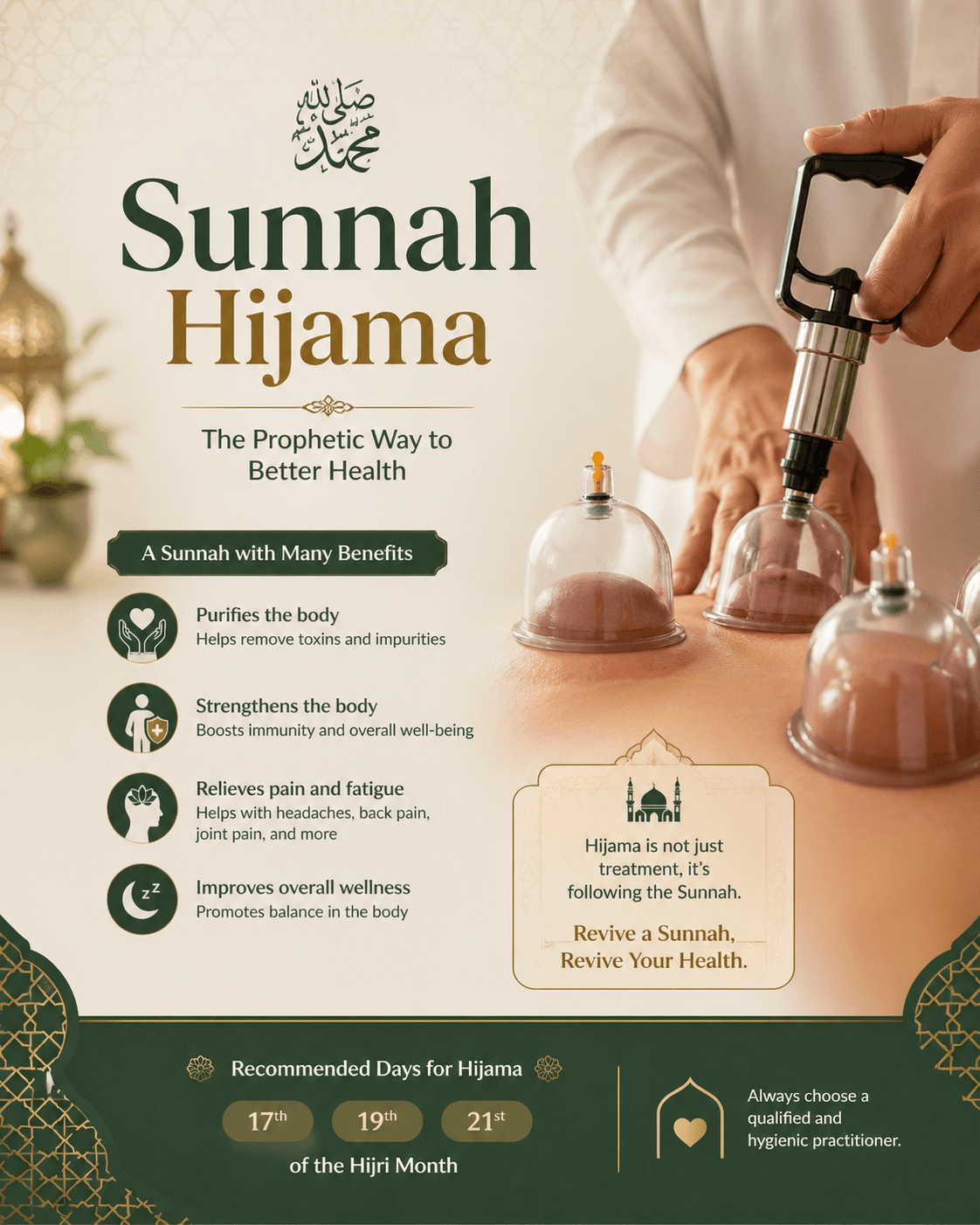
On top of the physical benefits, many patients describe a distinct feeling of lightness after a session — partly physiological, partly the psychological weight of finally doing something for themselves. From the Sunnah side, there is also a spiritual dimension many patients value. Choosing to follow a practice that the Prophet ﷺ recommended, and doing so on the specific days he encouraged, is itself a form of worship and intention-setting that a purely clinical treatment does not offer.
Wet Cupping vs Dry Cupping: Don't Get Them Confused
This is where most first-time visitors get caught out, especially when they compare prices online.
Dry cupping uses suction only. The practitioner places cups on the skin, draws up the tissue, and leaves them in place for several minutes. It increases local blood flow, loosens fascia, and relieves muscular tension. Athletes use it. Physiotherapists use it. It leaves temporary circular bruising but no open skin.
Wet cupping (Hijama) adds a second step. After the initial suction, the practitioner removes the cup, makes tiny superficial scratches on the skin with a sterile blade, and reapplies the cup. The vacuum then draws a small amount of blood out. This is the Sunnah method and the one associated with the stronger detoxification claims.
The two therapies feel different, cost different, and are used for different goals. If a clinic is advertising "Hijama" at a suspiciously low price, always confirm whether they mean wet or dry cupping before you book.
The Sunnah Days: Why Dates Matter to Many Patients
Many patients ask us whether the day of the month matters. From a strictly physiological standpoint, a well-performed Hijama session will do its job on any day. But from the Sunnah perspective, the Prophet ﷺ specifically encouraged Hijama on the 17th, 19th, and 21st of the lunar (Hijri) month.
At Royal Treat Clinic, we see the booking diary fill up around those dates every single month. If you want to align your session with the Sunnah, plan ahead — these slots go quickly, especially around Ramadan and the days right after Eid. If your schedule does not allow it, that is fine too; the therapy itself remains beneficial on any day of the month.
What Actually Happens at a Hijama Session
If you have never done it before, the unknown is usually what makes people hesitate. Here is what a real, well-run Hijama appointment looks like from the moment you walk in to the moment you leave.
- Consultation (5–10 minutes): A licensed practitioner asks about your medical history, current medications, recent blood tests, any chronic conditions, and the specific issues you want to address. If you are diabetic, on blood thinners, pregnant, or recently recovered from surgery, this is where we decide whether Hijama is safe for you, and if so, which points to use.
- Preparation: You lie down on a clean treatment bed, usually face down first if we are working on the back. The skin is sterilised with alcohol wipes. Every instrument used on you — cups, blades, gloves — is single-use and opened in front of you. This is non-negotiable and is how you tell a safe clinic from an unsafe one.
- Dry suction phase (2–3 minutes): Cups are placed on the treatment points and the air is pumped out, drawing the skin up into the cup. You feel a firm pulling sensation. Most patients describe it as strange but not painful.
- Scarification (30 seconds per point): The cups are removed and the practitioner makes a series of very small, superficial scratches on the skin using a sterile disposable blade. This is not a deep cut. The depth is minimal — just enough to allow blood to seep out with suction.
- Wet suction phase (5–10 minutes): The cups are placed back over the scratched area and the vacuum is reapplied. Over the next few minutes, a small amount of dark, stagnant blood is drawn into the cup. Volume varies per person and per point.
- Cleaning and dressing: Cups are removed, the area is cleaned thoroughly with antiseptic, and clean dressings are applied. You will see light circular marks on your skin for five to ten days. These fade naturally and are not bruises in the painful sense.
- Post-session guidance: Your practitioner talks you through what to eat, what to avoid, and when to come back.
A full appointment typically takes 45 to 60 minutes. Most patients walk out feeling lighter than they walked in.
What Hijama Can Help With (and What It Cannot)
It is important to be honest here, because too much of the online content around Hijama overpromises. Hijama has strong anecdotal and traditional support for:
- Musculoskeletal pain — lower back, upper back, shoulders, neck, sciatica.
- Headaches and migraines, particularly tension-type.
- Circulatory sluggishness in the lower limbs.
- Stress, insomnia, and general tension.
- Post-exercise recovery when combined with dry cupping.
- Certain skin conditions when used as part of a broader treatment plan.
Hijama is not a substitute for cancer treatment of any kind, treatment for acute infections, management of uncontrolled diabetes or hypertension, cardiac or kidney conditions requiring specialist care, or mental health conditions that require therapy or medication. A responsible clinic will tell you this plainly. If anyone promises to "cure" a chronic disease with cupping alone, walk out.
Who Should Avoid Hijama
Hijama is generally safe when performed by a licensed practitioner, but it is not suitable for everyone. You should not have wet cupping if you are:
- Pregnant, especially in the first and third trimesters.
- On blood-thinning medication (warfarin, high-dose aspirin, etc.).
- Living with haemophilia or any bleeding disorder.
- Severely anaemic.
- Recently discharged from surgery and still healing.
- Running a fever or fighting an active infection.
Children, the elderly, and patients with chronic conditions can often still benefit from Hijama, but only after a proper consultation with a licensed doctor.
How to Choose a Hijama Clinic in Dubai
Dubai is full of options, from home-visit practitioners advertising on Instagram to full medical centres. Price is not the only factor; safety and competence matter far more. When you are comparing clinics, look for:
- DHA licensing. The clinic and the individual practitioner should both be licensed by the Dubai Health Authority. Ask to see it. Legitimate clinics will not hesitate.
- Single-use, sterile equipment. Cups, blades, gloves, and dressings should all be disposable and opened in front of you.
- A real consultation. If no one asks about your medical history before the cups come out, leave.
- Clean, private treatment rooms — not a shared mat on the floor.
- Separate male and female practitioners where needed, which matters to many patients in the UAE.
- Transparent pricing with no pressure to buy packages during your first visit.
- Clear aftercare instructions, in writing if possible.
A good Hijama experience should feel like visiting a clinic, not a backroom.
How Much Does Hijama Cost in Dubai?
Prices across the emirate vary more than most people realise. A standard Hijama session in Dubai usually ranges from around AED 250 to AED 500, depending on the clinic's location, the number of points treated, and whether the practitioner is a specialist doctor.
At Royal Treat Clinic, we have deliberately priced our signature Hijama package at AED 150 for up to 17 cups, because we believe a Sunnah therapy should not be treated as a luxury product. You get a full clinical experience — licensed practitioner, sterile equipment, private room — at a price point that actually lets you come back every month if you choose to. That is the point of a therapy rooted in regular practice.
Aftercare: What to Do in the 24 Hours After Your Session
How you treat your body after Hijama matters almost as much as the session itself. The basics:
- Rest for the remainder of the day. Avoid the gym, avoid heavy lifting.
- Drink plenty of water. Your body has just been nudged into a light healing response; hydrate well.
- Eat light and clean — soups, fruit, vegetables, lean protein. Avoid red meat, heavy fried food, and dairy for at least 24 hours. Many traditional practitioners extend this to 48 hours.
- Avoid cold air directly on the Hijama points for the first 24 hours. That means no direct AC draft, no cold showers, no swimming pool.
- Keep the dressings dry for the first few hours. You can shower the next morning.
- Watch for any signs of infection — unusual redness, warmth, or pus. This is extremely rare when the session is performed correctly, but if it happens, call your clinic the same day.
Most patients feel a deep, almost sleepy calm the evening of their session. Lean into it. That rest is part of the treatment.
How Often Should You Do Hijama?
There is no single right answer. As a general guide:
- If you are new to Hijama and have a specific complaint (chronic back pain, migraines, sciatica), a once-a-month session for three months is a reasonable starting point.
- Once your symptoms stabilise, most patients move to a maintenance schedule of once every two to three months.
- For purely Sunnah-driven practice, many patients come in monthly, ideally aligned with the 17th, 19th, or 21st of the Hijri month.
Your practitioner should adjust the recommendation based on how your body responds. If nothing is changing after three sessions, the issue probably needs a different approach, and any honest clinic will tell you that.
Frequently Asked Questions About Hijama in Dubai
Does Hijama hurt?
The scratches are very superficial. Most patients describe the sensation as a light scratch or a pinch, nothing close to the pain of an injection. The firm pulling of the cups is more noticeable than the incisions.
Will it leave scars?
No. The scratches are too shallow to leave permanent marks. You will see circular pressure marks for five to ten days that fade on their own.
Can I do Hijama during Ramadan?
Yes. In fact, many patients specifically book Hijama during Ramadan, ideally after iftar so the body is not fasting during the session. Check with your practitioner about the best timing for your situation.
Is Hijama suitable for women?
Absolutely. We have female practitioners who treat female patients in fully private rooms. Please mention this preference when booking so we can arrange the schedule.
How quickly will I feel results?
Some patients feel relief the same day, especially for muscular pain. For deeper issues like chronic fatigue or circulation problems, it may take two or three sessions before you notice meaningful change.
Can I combine Hijama with physiotherapy or massage?
Yes, and we often do. Hijama pairs well with physiotherapy for back and shoulder issues. We just recommend spacing them a few days apart so your body can respond to each therapy separately.
Booking Your First Session at Royal Treat
If you have read this far, you are probably close to booking. Here is how to take the next step without any pressure.
We offer Hijama every day at Royal Treat Clinic in Deira, Dubai, with licensed male and female practitioners, fully sterile disposable equipment, and private treatment rooms. Our signature Sunnah Hijama package is AED 150 for up to 17 cups and includes the consultation, the full session, and aftercare guidance.
To book, message us on WhatsApp and one of our team will confirm a time that works for you — usually the same day or the next. If you have a specific concern (back pain, migraines, fatigue, post-Namaz discomfort), mention it when you message so we can assign the right practitioner and plan the session properly.
You do not need to commit to a package. Come in once, see how your body responds, and decide from there. That is how a real therapy is meant to be offered.
Ready to Book Your Hijama Session?
Experience authentic Sunnah Hijama at Royal Treat Clinic in Deira, Dubai — AED 150 for up to 17 cups, licensed practitioners, and fully sterile disposable equipment. Message us on WhatsApp at +971 50 972 3913 to secure a slot, especially around the 17th, 19th, and 21st of the Hijri month.
Share this article
Help others discover the path to holistic wellness
Related Articles
Sunnah Hijama: The Prophetic Guide to Wet Cupping, Hijri Days, and Practice in Dubai
A grounded guide to Sunnah Hijama in Dubai — the hadith, the 17th/19th/21st Hijri days, the Sunnah body points, etiquette, and how Royal Treat Clinic in Deira books these dates.

Hijama Cupping Therapy in Dubai — Benefits, Procedure & What to Expect
A comprehensive guide to Hijama cupping therapy in Dubai, covering its history, Islamic significance, health benefits, and what happens during a session at Royal Treat Clinic in Deira.